Javascript Tree Explorer by Deluxe-Tree.com
Javascript Tree Explorer


Buy Now!  Free Trial Download

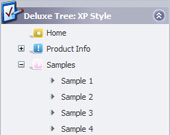
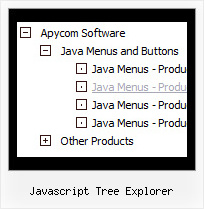
Menu Screenshots Javascript Tree Explorer

Javascript Tree Explorer Javascript Tree Pop

Features Javascript Tree Explorer

Unrivalled Features
  • Scrollable, dragable, floating
  • Unique Java Script API for altering menu "on-the-fly", without page reloading
  • AJAX technology - loads menu data from the server "on-fly and on-demand".
Compatibility              
  • Full cross-browser compatibility including IE, Netscape, Mozilla, Opera, Firefox, Konqueror and Safari on Windows, Mac OS and Linux
  • Menu can be populated from a database using ASP, PHP, etc.
  • Search engine friendly
  • Support for any doctypes
  • Fits for secure sites
Tree Forms Drop Down Javascript Tree Explorer
Cost Effective
Professional Look-n-feel
  • Entirely customizable look-n-feel
  • A lot of pre-designed javascript tree explorer samples
  • Hundreds of visual effects
  • Custom CSS styles can be applied for all menu settings
Seamless Integration
  • Visible over flash, select boxes, iframes, java applets
  • Multiple menus on the same page
  • Amicable to other scripts and css styles
  • Any HTML code can be used inside menu items
Buy Now!  Free Trial Download

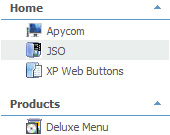
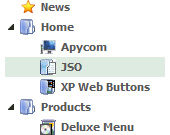
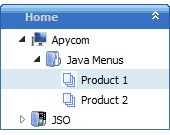
Javascript Tree Menu. Expandable Menu.

  • You can set default expanded/collapsed items and submenus.
  • After clicking on menu item selected item becomes highlighted.
  • When the submenu is larger than the visible area of the page the submenu will be automatically decreased. To see all the submenu items you do not need to use scrollbars or something like that - just put your mouse to the bottom of a submenu and it will be automatically scrolled! You can also specify height and width for each separate submenu.
  • There is no need to write additional code on a server side to remember what items were expanded/collapsed. Javascript/DHTML Tree can save items state automatically!

Recent Questions Javascript Tree Explorer

Q: In Firefox, the java popup menu is hidden behind Flash player. Anyway to fix this?


A: See fix for flash in Firefox here:

http://deluxe-menu.com/objects-overlapping-sample.html


Q: Is it possible to open a specific tab using javascript in the horizontal tabbed?

A: You can try to use the following function:

dtabs_itemClick(menuN, itemN);

where
menuN - index of a menu on a page, >= 0.
itemN - index of a tab you want to show, >=0.


Q: With the new version, my body onload function is blocked.
In our application we do something with a body onload function.
It doesn't get called if I use the deluxe-menu. If I remove deluxe-menu js files from html, it works.

Is there a way I can use deluxe-menu and get my onload handler called?


A: JavaScript Tree Menu detects any user's onload events and remember them in the case when you write a such events before dm_init(); call.

Try to delete onload event from <body> and write the following at theend of a page (after dm_init() call):

<script type="text/javascript"> onload = onloadHandler;</script>

That should work.


Q: I want to set up dhtml tab on my page, and have HTML code inside the tab,
rather than have the tab be a link.
I'm having trouble figuring this out. Can you help?
In other words, when a user clicks on a tab, I want a table to display below
the tabs instead of it being a link.

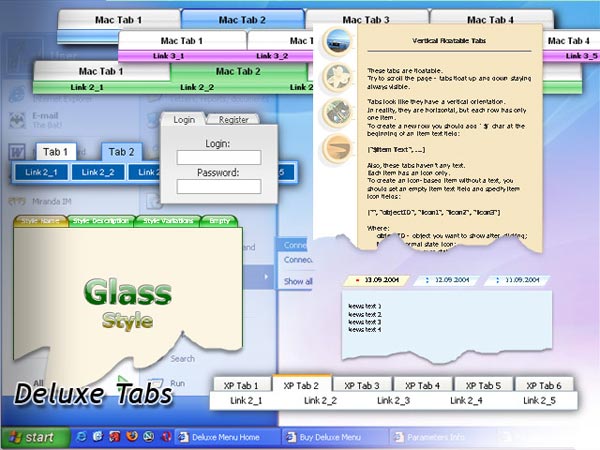
A: See in Deluxe Tabs there are two modes:

1.   var tabMode=0;
You can create only one level of tabs and assign Object Id's of the
DIV's to show when you click on the tab.

["XP Tab 1","content1", "", "", "", "", "", "", "", ],
["XP Tab 2","content2", "", "", "", "", "", "", "", ],
["XP Tab 3","content3", "", "", "", "", "", "", "", ],
["XP Tab 4","content4", "", "", "", "", "", "", "", ],

2.   var tabMode=1;
You can assign only links in this mode.
You should create top level items with subitems.

["XP Tab 1","", "", "", "", "", "", "", "", ],
 ["|Link 1_1","http://deluxe-tabs.com", "", "", "", "", "0", "", "", ],
 ["|Link 1_2","testlink.htm", "", "", "", "", "0", "", "", ],
 ["|Link 1_3","testlink.htm", "", "", "", "", "0", "", "", ],
 ["|Link 1_4","testlink.htm", "", "", "", "", "0", "", "", ],
 ["|Link 1_5","testlink.htm", "", "", "", "", "0", "", "", ],
["XP Tab 2","", "", "", "", "", "", "", "", ],
 ["|Link 2_1","testlink.htm", "", "", "", "", "0", "", "", ],
 ["|Link 2_2","testlink.htm", "", "", "", "", "0", "", "", ],
 ["|Link 2_3","testlink.htm", "", "", "", "", "0", "", "", ],
 ["|Link 2_4","testlink.htm", "", "", "", "", "0", "", "", ],
 ["|Link 2_5","testlink.htm", "", "", "", "", "0", "", "", ],
["XP Tab 3","", "", "", "", "", "", "", "", ],
 ["|Link 3_1","testlink.htm", "", "", "", "", "0", "", "", ],
 ["|Link 3_2","testlink.htm", "", "", "", "", "0", "", "", ],
 ["|Link 3_3","testlink.htm", "", "", "", "", "0", "", "", ],
 ["|Link 3_4","testlink.htm", "", "", "", "", "0", "", "", ],
 ["|Link 3_5","testlink.htm", "", "", "", "", "0", "", "", ],

You can use Object ID as well as Link in both modes. Use the following prefixes within item's link field:
"object:" - means that there is object id after it;
"link:" - means that there is a link after it.
"javascript:" - means that there is a javascript code after it, for example:javascript:alert(\'Hello!\')

So, you should write for example:

 ["|Link 1_1","object:Content1_1", "", "", "", "", "0", "", "", ],