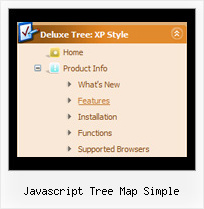
Javascript Tree Map Simple by Deluxe-Tree.com
Javascript Tree Map Simple


Buy Now!  Free Trial Download

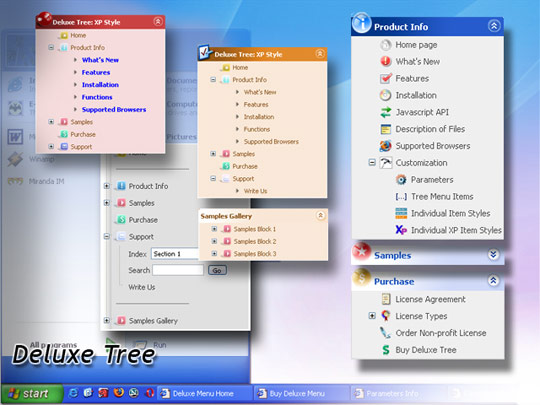
Menu Screenshots Javascript Tree Map Simple

Javascript Tree Map Simple Menubar Tree

Features Javascript Tree Map Simple

Compatibility              
  • Full cross-browser compatibility including IE, Netscape, Mozilla, Opera, Firefox, Konqueror and Safari on Windows, Mac OS and Linux
  • Menu can be populated from a database using ASP, PHP, etc.
  • Search engine friendly
  • Support for any doctypes
  • Fits for secure sites
Seamless Integration
  • Visible over flash, select boxes, iframes, java applets
  • Multiple menus on the same page
  • Amicable to other scripts and css styles
  • Any HTML code can be used inside menu items
Tree Windows Interface Javascript Tree Map Simple
Easy Setup
  • De Luxe Tuner. GUI interface to create your javascript tree map simple menus easily and in no time
  • Sensible menu parameters for manual editing
High Performance
  • AJAX menu loading - loads web menu data from the server "on-the-fly".
  • Commonly loads quicker than other html page elements
  • Runs well with an unlimited number of submenus and items
Unrivalled Features
  • Scrollable, dragable, floating
  • Unique Java Script API for altering menu "on-the-fly", without page reloading
  • AJAX technology - loads menu data from the server "on-fly and on-demand".
Buy Now!  Free Trial Download

Javascript Tree Menu. Expandable Menu.

  • Tune menu parameters manually or using Deluxe Tuner. Then add several rows of a code within html page - your menu is ready!
  • Use special JavaScript functions for: Dynamic changing of items (text, link, icons and even individual style!). Making a menu item active/disabled. Addition/removing of items. Changing of visibility of items. Collapsing/expanding of items. Getting the information on any menu, submenu and items. Other tricks. But for all that it's not necessary to insert any additional code into all the pages - just specify some additional parameters of the menu.

Recent Questions Javascript Tree Map Simple

Q: I have bought this from you. What is the name of the divlayer(s)? Here's a bit of the modified menu code:

 ["|<iframe height=400 width=435 frameborder=0 scrolling=no src=my_bookmarks.asp></iframe>","","","","0",,,],

I open an Iframe inside the javascript menu design item, and it works fine, but is there a way to close it? I know the commands for hide layers, but I can't find any div layer names to use.

A: I'm not sure I understand you.

Do you want to hide your items?

You can try to use API functions

function dm_ext_changeItemVisibility (menuInd, submenuInd, itemInd, visibility)

Find more info here:

http://deluxe-menu.com/functions-info.html


Q: There does not appear to be any information how to display the content of a selected tab for the tab menu

A: If you want to see the content below your tab menu:

you should paste your content in the <div> .. </div> tags.

<div id="content1" style=" visibility: hidden;" class="tabPage">

<p align=center><img src="img/logo_DM.gif" width=262 height=56 alt="Deluxe-Menu.com"></p>

</div>


<div id="content2" style="visibility: hidden;" class="tabPage">
<p align=center><img src="img/logo_DT.gif" width=262 height=56 alt="Deluxe-Tree.com"></p>
</div>


<div id="content3" style=" visibility: hidden;" class="tabPage">
<p align=center><img src="img/logo_DTabs.gif" width=254 height=58 alt="Deluxe-Tabs.com"></p>
</div>


See in Deluxe Tabs there are two modes:

1.   var tabMode=0;
You can create only one level of tabs and assign Object Id's of theDIV's to show when you click on the tab.

["XP Tab 1","content1", "", "", "", "", "", "", "", ],
["XP Tab 2","content2", "", "", "", "", "", "", "", ],
["XP Tab 3","content3", "", "", "", "", "", "", "", ],
["XP Tab 4","content4", "", "", "", "", "", "", "", ],

2.   var tabMode=1;
You can assign only links in this mode.
You should create top level items with subitems.

["XP Tab 1","", "", "", "", "", "", "", "", ],
 ["|Link 1_1","http://deluxe-tabs.com", "", "", "", "", "0", "", "", ],
 ["|Link 1_2","testlink.htm", "", "", "", "", "0", "", "", ],
 ["|Link 1_3","testlink.htm", "", "", "", "", "0", "", "", ],
 ["|Link 1_4","testlink.htm", "", "", "", "", "0", "", "", ],
 ["|Link 1_5","testlink.htm", "", "", "", "", "0", "", "", ],
["XP Tab 2","", "", "", "", "", "", "", "", ],
 ["|Link 2_1","testlink.htm", "", "", "", "", "0", "", "", ],
 ["|Link 2_2","testlink.htm", "", "", "", "", "0", "", "", ],
 ["|Link 2_3","testlink.htm", "", "", "", "", "0", "", "", ],
 ["|Link 2_4","testlink.htm", "", "", "", "", "0", "", "", ],
 ["|Link 2_5","testlink.htm", "", "", "", "", "0", "", "", ],
["XP Tab 3","", "", "", "", "", "", "", "", ],
 ["|Link 3_1","testlink.htm", "", "", "", "", "0", "", "", ],
 ["|Link 3_2","testlink.htm", "", "", "", "", "0", "", "", ],
 ["|Link 3_3","testlink.htm", "", "", "", "", "0", "", "", ],
 ["|Link 3_4","testlink.htm", "", "", "", "", "0", "", "", ],
 ["|Link 3_5","testlink.htm", "", "", "", "", "0", "", "", ],


You can use Object ID as well as Link in both modes. Use the following prefixes within item's link field:
"object:" - means that there is object id after it;
"link:" - means that there is a link after it.
"javascript:" - means that there is a javascript code after it, for example:javascript:alert(\'Hello!\')

So, you should write for example:

 ["|Link 1_1","object:Content1_1", "", "", "", "", "0", "", "", ],

Q: Deluxe Tunes says:-  “Use "File/Export to HTML" to see how to write the code within html page.”

If I use this the generate the code it places the