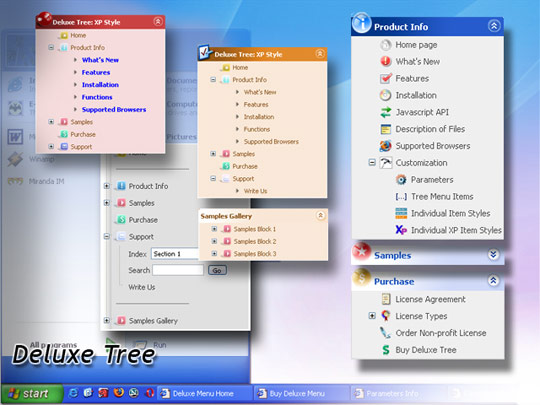
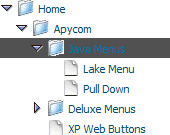
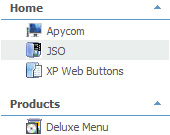
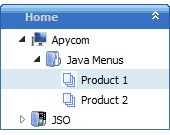
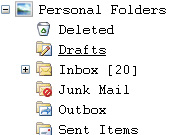
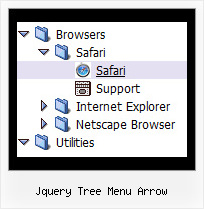
The template emulates Vista OS menu style. To open submenus click on menu items. The appearence of this template is determined by the following parameters:
- The menu have XP Style; Animation effect for subitems - Toggle-mode support. - Items have icons - Menu has a static position and is placed within the table cell
Key features:
- Vertical orientation of the Tree Menu - Movable and floatable menu - Items with icons - Several menus on one page - Submenus expand/collapse on mouseover - Personal CSS styles for separate menu elements - Status string shows item labels - Image arrows
Tune menu parameters manually or using Deluxe Tuner. Then add several rows of a code within html page - your menu is ready!
Use special JavaScript functions for: Dynamic changing of items (text, link, icons and even individual style!). Making a menu item active/disabled. Addition/removing of items. Changing of visibility of items. Collapsing/expanding of items. Getting the information on any menu, submenu and items. Other tricks. But for all that it's not necessary to insert any additional code into all the pages - just specify some additional parameters of the menu.
Q: Could you please tell me, wether it is possible to place the arrows in the front of the javascript web menu items instead of after. I am working on a Vista menu.
A: Try to use the following javascript web menu parameter:
var dmRTL=1;
Q: I have notices that using IE7 on a W2K3-R2 browsing your page I can't see the javascript collapsible menu, it happened in our development as well.
A: Your browser has JavaScript option disabled. It means that no one JavaScript element can be run. You should to enable JavaScript in IE:
Tools -> Internet Options -> Security -> Custom level... -> Scripting -> Active Scripting = Enable
Q: Compliments on your product, I particularly enjoy the complete set of gui and java, that allows for the quick changes.
After a couple of months of using the trial, I have now purchased it and installed the license.
My question however regards the performance of the menu. Using firebug I note that my deluxe menu .js are the performance bottlenecks, It appears as if they are not being cached and it appears that collecting them is taking longer then the other .js files. What can I do to optimize the load time of the javascript multi level menu and prevent, reloading it from the server with every page reload. The apache has set the expiry correct I believe, as I understand from the header.
A: You can try to use AJAX technology.
AJAX-like technology: data for submenus can be loaded "on-the-fly" from the server.
New parameter: var tajax = 0/1; - disables/enables AJAX-like support
Current syntax for item parameters ( var tmenuItems): [text, link, iconNormal, iconOver, iconExpanded, tip, target, itemStyleInd, itemXPStyleInd, jsFileName]
Where jsFileName - .js filename on the server with submenu items ( var tmenuItems).
Q: Dreamweaver navigation bar disappearing behind flash file in Firefox..
Download Drop Down Menue 9.4 Free trial - Easily make enable you to build versatile cross-browser web menus in clicks. Integrate with main web jQuery Drop Down Menu Style 2. jQuery Drop Down Menu, Web Buttons, Animated jQuery
Archive for the Menu & Navigation' Category Free Web Resources Everyday - WebResourcesDepot With a XHTML 1.0 strict validated output, this treemenu supports unlimited number of levels and remembers the state between
Softpedia Webscripts All mcDropdown This is a jQuery plugin to build and produce a navigational and filterable drop-down menu � Press [UP ARROW] or [DOWN ARROW] to cycle through valid options.
Giva Labs - mcDropdown jQuery Plug-in | Giva The Giva Labs provides code tips and source code to the development community. more compact layoutwhich we believe offers quicker selection of the menu items.
Javascript Menus jQuery Popup Menu Tutorial A folding DHTML menutree with persistance feature, created via cookies. the arrow image's full path, animation speed, plus delay before menu appears/ disappears onMouseover:
Arrow Buttons. WebMenu Creator Arrow Buttons. Help visitors find what they search for on your website! Try Vista Buttons! Fancy Button Images
Plugins | jQuery Plugins Check out the jQuery Wiki page. Are you a plugin developer? Please move your plugin over jQuery Plugin website issue queue to ensure it is noticed! jQuery
Giva Labs - mcDropdown jQuery Plug-in | Giva The Giva Labs provides code tips and source code to the development community. more compact layoutwhich we believe offers quicker selection of the menu items.
XP Style Blue - Button Image Create Button Image and DHTML Menu for Your Web Site in a Few Clicks! Javascript Popup Window | Lightbox JS | jQuery Lightbox | jQueryMenu | TreeMenu. Home | Buy Now!
25 JQuery Menus Ready For Download | Design your way JQuery is one of the most interesting things that you can find on a site. Starting from Arrow Side Menu is a vertical list based menu that uses a single background image to
Archive for the Menu & Navigation' Category Free Web Resources Everyday - WebResourcesDepot With a XHTML 1.0 strict validated output, this treemenu supports unlimited number of levels and remembers the state between
jQuery UI Development & Planning Wiki / Mobile Instead of simply tweaking the existing jQuery UI widgets to work on mobile, code to latest jQuery UI: http://github.com/pbakaus/jquery-ui/tree/touchready
DHTML Javascript Menu. Deluxe Menu. v3.15 Deluxe Menu is cross-frame and cross-browser DHTML Javascript menu with a lot of powerful features, flexible parameters and easy installation.