Menu Dtree by Deluxe-Tree.com
Menu Dtree


Buy Now!  Free Trial Download

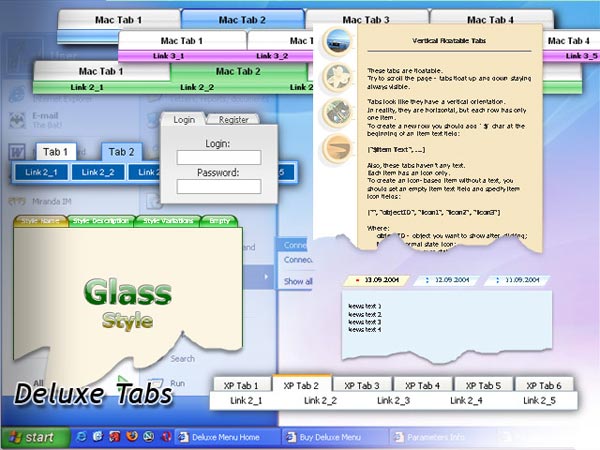
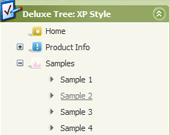
Menu Screenshots Menu Dtree

Menu Dtree Tree Menubar Example

Features Menu Dtree

Compatibility              
  • Full cross-browser compatibility including IE, Netscape, Mozilla, Opera, Firefox, Konqueror and Safari on Windows, Mac OS and Linux
  • Menu can be populated from a database using ASP, PHP, etc.
  • Search engine friendly
  • Support for any doctypes
  • Fits for secure sites
Seamless Integration
  • Visible over flash, select boxes, iframes, java applets
  • Multiple menus on the same page
  • Amicable to other scripts and css styles
  • Any HTML code can be used inside menu items
Javascript Tree Popmenu Menu Dtree
High Performance
  • AJAX menu loading - loads web menu data from the server "on-the-fly".
  • Commonly loads quicker than other html page elements
  • Runs well with an unlimited number of submenus and items
Easy Setup
  • De Luxe Tuner. GUI interface to create your menu dtree menus easily and in no time
  • Sensible menu parameters for manual editing
Professional Look-n-feel
  • Entirely customizable look-n-feel
  • A lot of pre-designed menu dtree samples
  • Hundreds of visual effects
  • Custom CSS styles can be applied for all menu settings
Buy Now!  Free Trial Download

Javascript Tree Menu. Expandable Menu.

  • You can set default expanded/collapsed items and submenus.
  • After clicking on menu item selected item becomes highlighted.
  • When the submenu is larger than the visible area of the page the submenu will be automatically decreased. To see all the submenu items you do not need to use scrollbars or something like that - just put your mouse to the bottom of a submenu and it will be automatically scrolled! You can also specify height and width for each separate submenu.
  • There is no need to write additional code on a server side to remember what items were expanded/collapsed. Javascript/DHTML Tree can save items state automatically!

Recent Questions Menu Dtree

Q: How can I keep the javascript contextual menu items from opening into a new window when selected?

A: You can set target parameter for all javascript contextual menu items:

  var itemTarget="_self";

or for each item individually:

["Home","testlink.html", "", "", "", "_self", "", "", "", "", "", ],


Q: We currentlly have a menu that uses standard html hyperlinks to open a new window with _blank as the target. Unfortunately, the size of the window is controlled by the browser and we want to be able to control it. The only way that we know how to do that is to use the window.open client-side function and pass the window's dimensions. Here is a sample of the code that would do that:

window.open("url","_blank","height=1024,width=768,status=yes,toolbar=no,menubar=no,location=no");

How can we add the javascript code to the down menus css instead of a link? Do you have any samples?


A: You can use javascript code within menuItems, for example

["Test Window","javascript:window.open('http://www.microsoft.com','_blank','height=1024,width=768,status=yes,toolbar=no,menubar=no,location=no');", , ,'Monitor Exceptions' , ,'0', '0',,],


Q: I have in my script the following entry

<script type="text/javascript" language="JavaScript1.2" src="resources/deluxe-menue/dmenu.js"></script>

<noscript><a href=http://deluxe-menu.com/>(c)2008 Javascript Menu by Deluxe-Menu.com</a></noscript>

but I get the notice "Incorrect Copyright" in my double drop down menu. What did I make wrong?

A: You should write NOSCRIPT tag in the following way:

<noscript><a href="http://deluxe-menu.com">(c)2008 double drop down menu by Deluxe-Menu.com</a></noscript>

Make sure that you're using last version of JavaScript Tree Menu.

You can download last version of JavaScript Tree Menu from the same link inyour license message.


Q: The arrows on my cross browser javascript menu only show on the main page of my website (www.domain.com). I read the FAQs and the problem seems common and related to a path error. My path appears correct (to me anyway..lol) but it still doesn't work.

A: Try to use absolute path to your images. Set the following parameter:

  var pathPrefix_img="http://www.domain.com/";